Op-Ed in Washington Examiner by Heritage research fellow James Carafano rips into the recently signed START agreement. To back his position up he uses a game devised by his colleague Baker Spring that demonstrated what a horrible world it would be if we followed Obama's "nuke-free world" plan. I will try not to quibble too much although it must be noted that Ronald Reagan had a vision of a nuclear-free world when Obama was still striking up spliffs. As I a Republican and a conservative I can take Carafano, Spring and Mitt Romney at their word and believe that this START thing isn't any good orrrrrr....I can listen to Henry Kissinger, George Schultz, James Baker, Colin Powell, Stephen Hadley and Brent Scowcroft who have all voice support for START. Hmmmm...this one is tough. A bunch of no-name researchers who have accomplished nothing in the foreign policy realm, a politician desperate to show off his tea party bona-fides or a who's who of the Republican foreign policy establishment?
Showing posts with label Obama. Show all posts
Showing posts with label Obama. Show all posts
Friday, August 06, 2010
Thursday, July 29, 2010
The Green Herring: Eco-Friendly Jobs Aren't Enough
The left-leaning New America Foundation issued Talking Points that note the obvious - green jobs will not be enough to kick start the economy. Just a snippet:
It was unwise of the Obama administration and Congress to rely so heavily on the renewable energy sector to drive the recovery. Spending on renewables is slow to get out of the door, leaks to foreign companies, is an inadequate driver of jobs and growth, and may not create a strong exporting industry.


Friday, July 23, 2010
Obama's Worst Nightmare? Really?
World Net Daily breathlessly asks if Herman Cain is Obama's worst nightmare...say what? In case you were wondering Herman Cain is thinking about running for president and since he is black...well, of course, because the only reason Obama is president is because he is black. So conservatives of the fringe really believe that if they get their own black guy then Obama will be crushed! I don't even know what to say or make out of this case of ODS.
Saturday, July 17, 2010
NYT: Economy Sucks. Blame the Rich!
Not only don't we tax them enough but those darned rich folk aren't spending enough to get us out of the recession. NYT has an article saying the rich are not spending enough to get us out of recession. What is interesting is how this parallels other articles noting how businesses and banks are holding onto cash. The narrative in those pieces is that uncertainty over Obama policies and increased regulation are scaring away investment. The narrative in the NYT piece is....well I have no idea. They manage not to mention anything or anyone even remotely tied to the Obama Admin. I mean, they do not even ask anyone in the government why the rich are not spending money. It is almost as if they are afraid that readers would make some sort of association and blame Obama anyway so they won't mention him in hopes that we might not blame him somehow for all this.
One last thing the article quotes an expert from "left-leaning" Institute for Policy Studies. Left-leaning? Is NYT going to start referring to the KKK as a fraternal organization?
Monday, March 10, 2008
The Hugo Dems
WSJ has an editorial on what it labels the "Chavez Democrats." WSJ correctly castigates the Dems for trying to slap down Colombia during its high stakes confrantation with Hugo. They also note that the "soft power" lovers of the left seem to have forgotten what soft power is about:
Even as Mr. Chávez was doing his war dance, Senate Finance Chairman Max Baucus was warning the White House not to send the Colombia deal to the Hill for a vote without the permission of Democratic leaders. He was seconded by Ways and Means Chairman Charlie Rangel, who told Congress Daily that "they don't have the votes for it, it's not going to come on the floor," adding that "what they [the White House] don't understand it's not the facts on the ground, it's the politics that's in the air."
Mr. Rangel is right about the politics. No matter what U.S. strategic interests may be in Colombia, this is an election year in America. And Democrats don't want to upset their union and anti-trade allies. The problem is that the time available to pass anything this year is growing short. The closer the election gets, the more leverage protectionists have to run out the clock on the Bush Presidency. The deal has the support of a bipartisan majority in the Senate, and probably also in the House. Sooner or later the White House will have to force the issue.
Unfortunately the ed. goes overboard bringing up the supposed fraud of the Hugo recall of 2004. Fraud or not he still had overwhelming support at the time. It was unlikely that he would have been defeated in that instance. WSJ singles out my personal favorites Delahunt and Dodd as being particularly close to Hugo:
These are the same Democrats who preach the virtues of "soft power" and diplomacy, while deriding Mr. Bush for being too quick to use military force. But trade is a classic form of soft power that would expand U.S. and Latin ties in a web of commercial interests. More than 8,000 U.S. companies currently export to Colombia, nearly 85% of which are small and medium-sized firms. Colombia is already the largest South American market for U.S. farm products, and the pact would open Colombia to new competition and entrepreneurship.
Which brings us back to Mr. Chávez and his many Democratic friends. Connecticut Senator Chris Dodd's early support helped the strongman consolidate his power. Former President Jimmy Carter blessed Mr. Chávez's August 2004 recall victory, despite evidence of fraud. And then there are the many House Democrats, current and former, who have accepted discount oil from Venezuela and then distributed it in the U.S. to boost their own political fortunes. Joseph P. Kennedy II and Massachusetts Congressman Bill Delahunt have been especially cozy with Venezuela's oil company. If Democrats spurn free trade with Colombia, these Democratic ties with Mr. Chávez will deserve more political scrutiny.
Senators Hillary Clinton and Barack Obama are both competing for union support. But if they wanted to demonstrate their own Presidential qualities, they'd be privately telling Ms. Pelosi to pass the Colombia pact while Mr. Bush is still in office. That would spare either one of them from having to spend political capital to pass it next year.Instead, both say they oppose the deal on grounds that Mr. Uribe has not done more to protect "trade unionists." In fact, Mr. Uribe has done more to reduce violence in Colombia than any modern leader in Bogotá. The real question for Democrats is
whether they're going to choose Colombia -- or Hugo Chávez.
Saturday, March 08, 2008
No Longer Obama's Problem From Hell
Samantha Power, Obama shill and lightning rod for the "Israeli Lobby" is no longer associated with the campaign. Her fall not so much being the object of the so-called lobby's ire but rather a hiccup of unadulterated honesty - she called Hillary a "monster." Despite being a fan of her Pulitzer prize winning book, A Problem From Hell: America in the Age of Genocide, I am not a fan of hers. She comes from the foreign policy school that seems to think that it is great to use the military for anything at all as long as it does not have anything whatsoever to do with our national interests. My only concern is that she has blown up too soon. There is ample time between now and January for her to resurface in an Obama administration.
Sunday, March 02, 2008
Obama and Other Hagel Loving Dems
Obama is making noises that he would be willing to consider a Republican in his cabinet. Retiring Chuck Hagel, taking McCain's place as every Dems favorite Rep, was mentioned. I'm sure it is just a coincidence but insufferable Chris Dodd mentioned Hagel today in the NYT.
There is an interview with Hagel in the latest issue of The American Interest (sub. required). At one point he sounds rather Obama-ish, although he actually means it while Obama, the most leftist member of the Senate (take that Ted!), seems to only pay lip service to the end of partisanship:
There is an interview with Hagel in the latest issue of The American Interest (sub. required). At one point he sounds rather Obama-ish, although he actually means it while Obama, the most leftist member of the Senate (take that Ted!), seems to only pay lip service to the end of partisanship:
AI: With 11 years gone and one more to go in the Senate, how do you think back on your time here? Some say you’ve moved from many standard conservative positions to more centrist ones. You think that’s a fair description?
Senator Hagel: It is, and part of it has to do with what I’ve learned about the complexity of most of the issues we face as a society. We’re rarely confronted with easy calls, with a clearly “right” and a clearly “wrong” side. Life generally is not that way. But some people, from both parties, like to live in a world of absolutes, and that has polarized politics and strangled any bipartisan progress. People won’t work toward any kind of compromise when they feel they’re giving up their values, standards and beliefs. It has become clear to me, over the course of my 11 years working in this sausage factory here, that without any consensus on how to behave in order to move our country forward, we’re essentially paralyzed. I’ve moved toward the middle because that’s where I think the effective solutions are.
I’ve also learned to better appreciate the importance of personal relationships in how things work here. I’ve seen this President of the United States establish virtually no personal relationships, and it has cost the country. His position has been, “It’s either my way or the highway, because I’m the Decider.” But when you don’t have the lubricant of personal relationships in a democratic government—any form of government, really, but especially a two-party democracy—the gears will lock up, and the system will break down. That’s what has happened, and both sides are to blame.
It’s a very distressing dynamic, but I think the next president will understand that and act on that. Better personal relationships will form, and we’ll see a bipartisan cabinet, among other changes. It’s not a matter of choice, because the challenges facing this country are so immense that we can’t afford another four years of paralysis.
Messing Up the Andes and LA
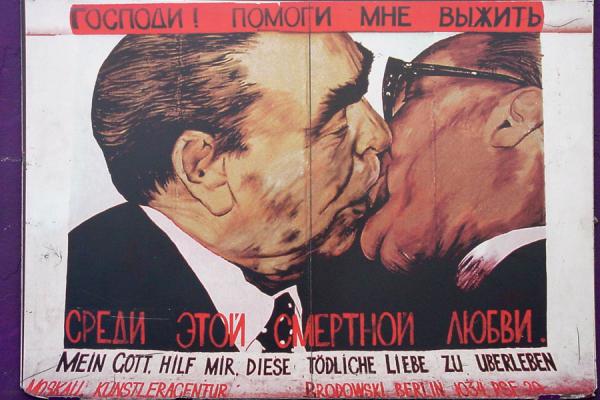
NYT has an editorial that focuses on Republican reluctance for free trade with certain Andean countries. Astounding when you consider that the two Dem candidates openly question current agreements such as NAFTA and do not seem inclined to do anything for our friends in LA. OB the Magnificent seems to be willing to bear hug Raulito and Hugo...who knows? If they are nice enough OB may even reenact the who Brezhnev/Honecker lip-lock with them.
Council of Foreign Relations has an excellent Daily Analysis on the Dem hatred for NAFTA along with some helpful links.
Council of Foreign Relations has an excellent Daily Analysis on the Dem hatred for NAFTA along with some helpful links.
Sunday, February 24, 2008
The Unintentionally Hilarious Tim Russert
On MTP they discussed the Obama plagiarizing kerfluffle. So who does Timmy turn to kick off the discussion, without a hint of irony mind you, Doris Kearns Goodwin. Now I don't mind Doris, actually I kind of like her. Maybe it has something to do with the young and undeniably hot Mira Sorvino playing her in the movie Quiz Show? (There's that seen where she is ready for bed and correctly answering the ridiculously challenging questions on "21." Speaking of Mira loved her in Barcelona - great flick every conservative would love. Sorry about the digression.) Oh God...where was I? Oh yeah, perhaps my fondness for Ms. KG stems from watching all 637 hours of Ken Burns' Baseball documentary mini-telenovela? Maybe, just maybe, I really liked Team of Rivals, even if I don't want to admit it. For the uninitiated Mrs. Goodwin had her own plagiarism problem.
Subscribe to:
Posts (Atom)